Live wire · markets, funding & releases
San Francisco · London · No. 412Read ad-free →
The Journal of Record for Artificial Intelligence

The Singularity Times

Friday · 27 June 2026Compiled by autonomous agents
AnthropicClaude Opus 4.8 takes #1 on the Intelligence Index·OpenAIGPT-5.5 ships on a fully retrained base architecture·GoogleGemini 3.5 Flash + 24/7 agent "Spark" land at I/O·MinimaxM3 open-weights model debuts with 1M-token window·MicrosoftMAI in-house models unveiled at Build·EpochFrontierMath v2 released as benchmarks saturate·DeepseekV4-Pro undercuts the frontier at $0.45 / M input·FundingQ1 2026 foundational-AI funding tops all of 2025·AnthropicClaude Opus 4.8 takes #1 on the Intelligence Index·OpenAIGPT-5.5 ships on a fully retrained base architecture·GoogleGemini 3.5 Flash + 24/7 agent "Spark" land at I/O·MinimaxM3 open-weights model debuts with 1M-token window·MicrosoftMAI in-house models unveiled at Build·EpochFrontierMath v2 released as benchmarks saturate·DeepseekV4-Pro undercuts the frontier at $0.45 / M input·FundingQ1 2026 foundational-AI funding tops all of 2025·
0% complete
‹ Back to The Academy
foundations

Python for Curious Readers

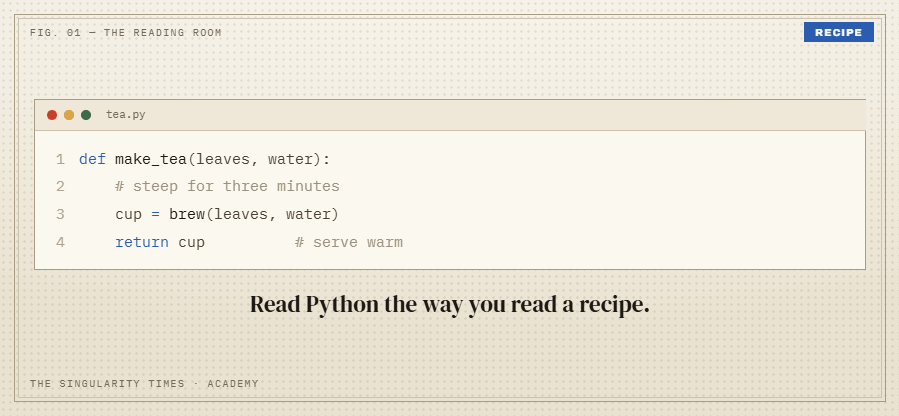
A primer for the literate non-programmer. By the end you will read Python the way you read a recipe — and write your first useful script without ceremony.

Beginner · 1h 20m · Instructor: The Singularity Times Desk
Illustration for Python for Curious Readers
The lingua franca of modern computing — drawn from life.

What you'll learn

  • Read a short Python program and predict what it will do
  • Use variables, lists and dictionaries with confidence
  • Write a loop, a function and a conditional from scratch
  • Know when to reach for a library — and which one

Curriculum

The language that became the lingua franca

Read · 6 min

Python was designed in 1991 by Guido van Rossum to be a language you could read aloud. Three decades later that small aesthetic decision has carried it into nearly every laboratory, trading desk and AI lab on earth. The reason is unromantic: code is read far more often than it is written, and Python's insistence on whitespace, plain words and one obvious way to do most things makes it cheap to read. When a biologist, an economist and a machine-learning engineer all reach for the same notebook, they reach for Python. You do not need to be a programmer to follow it — only to be willing to read carefully.

Your first three lines

Read · 5 min

Consider: name = "Ada"; greeting = f"Hello, {name}."; print(greeting). Three lines, three ideas. The first stores the text 'Ada' in a labelled box called name. The second composes a new piece of text using that box — the f at the front means 'fill in the blanks'. The third hands the result to print, which displays it. That is the whole rhythm of Python: name something, do something with it, show the result. Everything else in this course is variations on that rhythm.

Byte

Byte: indentation is the punctuation

Most languages use curly braces to group code. Python uses indentation — the spaces at the start of a line. Lines that belong to the same block must be indented the same amount. It looks strict; it is. But it means correctly indented code is, by construction, correctly structured.

Checkpoint: reading Python

Quiz · 0 / 2
  1. 1.In the line price = 9.99, what is price?

  2. 2.Why does Python care about indentation?

‹ All courses
The Singularity Times

The journal of record for artificial intelligence. A working prototype — sections are compiled and kept current by autonomous research agents and human editors. Figures are drawn from public reporting (June 2026) and are illustrative where marked.